

Snapshots presents Ketty Nez on 'far sight sun light'
Teaching the young composers gave me a chance to expose them to American theoretical and pedagogical practices, and they showed me trends in contemporary music current among the young generations in Hungary - our exchanges were definitely a two way street!
Could you tell us a little about your new album far sight sun light?
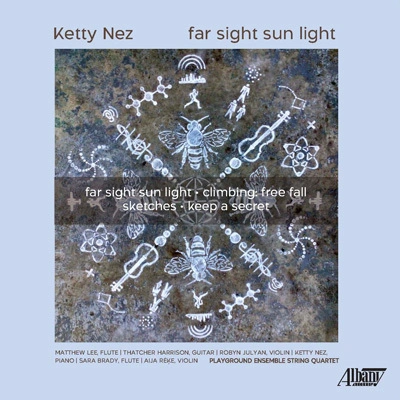
far sight sun light is a CD made up of folk-inspired chamber works written over the last several years, mainly during the COVID pandemic. As many artists, we struggled to maintain creative focus, and I would set out to write pieces I knew I may not hear for a long time to come, but always found sustaining inspiration in Central and East European folk sources (reflecting my Macedonian/Slovenian heritage). The compositions are inspired by Romanian, Turkish, and Croatian folk melodies, and my musical treatment of them ranges from overt (climbing: free fall, and sketches), or covered in thick layers of texture (keep a secret). A pianist myself, I always enjoy collaborating with other musicians, as in the piece climbing: free fall. This album also contains the first string quartet I’ve written, keep a secret. Writing in such an historically established genre, at a (relatively) developed stage in my own career, turned out to be a challenging leap of faith! (Given my positive experiences, however, I’ve since written two more quartets.)
far sign sun light, as well as your earlier compositions such as The Fiddler and the Old Woman of Rumelia, are heavily influenced by Eastern European folk tales. Could you tell us a little about the significance of these folk tales to you and why they became such a powerful influence?
Use of folk sources started by my having discovered by chance Yugoslav Folk Music by composer and ethnomusicologist Béla Bartók, which stunned me when I discovered it in 2008 in my school library, as it quite literally encapsulated both sides of my family heritage, Slovenian and Macedonian (“Yugoslavia” once included these countries), as well as my interests as a composer. The stories in these old Bosnian and Hercegovinan songs, collected in the 30’s, which Bartók transcribed and analyzed, are so graphic and gritty, that I decided to weave the stories and musical influences together to create a chamber folk opera a couple years later, The Fiddler and the Old Woman of Rumelia. I’ve written other chamber works since then, considering different ways to use a folk source – the lyrics, the melody, the rhythm, a musical gesture, perhaps fragmented beyond recognition, or presented as clear as a bell. This freely creative use of “the past,” and most importantly “someone else’s past,” recreates the porous and unreliable nature of memory. These songs and instrumental melodies are musical expressions of people who lived decades ago, living a way of agrarian life largely gone by now. One of Bartók’s abiding aims was to preserve, as closely as possible, a record of these disappearing cultures. In his case, it was the meticulous transcriptions he created from field recordings.
How did your Fulbright experiences in Budapest in 2021 deepen your musical practice?
My Fulbright in Budapest was a dream come true, to visit Bartók’s homeland, his haunts as student and young artist, and reacquaint myself with life in Central Europe in general. (Though born in Skopje, Macedonia, I grew up in the States.) I worked with scholars at the Bartók Archives, was invited to give a talk about my music there, and taught composers at the Franz Liszt Academy. These were some of the class rooms used by Bartók, as both student and teacher. I lived in a big city street where Bartók had lived as a student (though I didn’t manage to find the actual apartment). I collaborated with a Hungarian violinist equally fluent in the folk styles of performance as well as classical; he added improvisatory ornaments and inflections of performance techniques to my duo Postcards from the 1930’s, giving it a whole new dimension. Teaching the young composers gave me a chance to expose them to American theoretical and pedagogical practices, and they showed me trends in contemporary music current among the young generations in Hungary - our exchanges were definitely a two way street!
About
Ketty Nez joined the composition and theory department at the Boston University School of Music in 2005, after teaching for two years at the University of Iowa. Listen to a Wonder Never Heard Before!, her portrait CD as composer/pianist, was released in 2010 by Albany Records. Her folk opera, The Fiddler and the Old Woman of Rumelia, was premiered in a staged version in May 2012, by Juventas New Music Ensemble. Her piano concerto thresholds, performed by Ketty and the Boston University Wind Ensemble, was released in July 2013 by Ravello Records. BUWE also recorded four scenes for Juliet, released February 2019 by Summit Records. Her CD's of chamber music with Albany Records also include double images (2020), and far sight sun light (2023). During the fall term of 2021, Ketty was a guest teacher at the Liszt Academy in Budapest, Hungary, as a Fulbright scholar.