
Snapshots presents Gustavo Alonso López on 'Espasón'
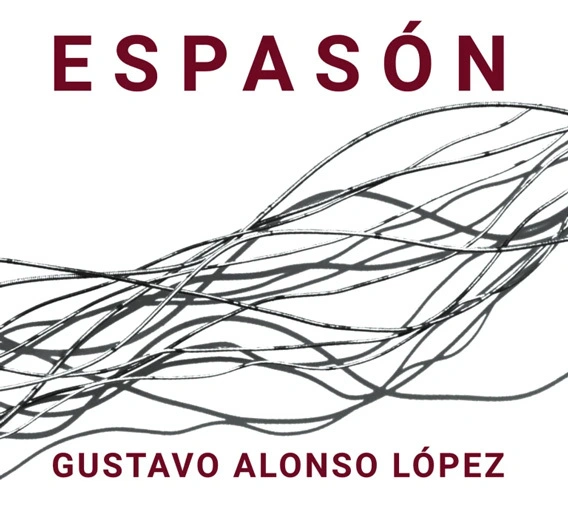
It became obvious that I could express all my emotions through flamenco, and could spend an entire lifetime learning from it and enjoying it.
Could you tell us a little about your new album Espasón, and what you find so powerful about flamenco?
Espasón is a contemporary Flamenco album. It’s a collaborative project featuring guest artists from Spain, Italy, and the United States, and is my second full-length studio album. Most of it was recorded at a small studio near Bellingham, Washington, but we also did some remote recording in Sevilla and Sanlucar de Barrameda, Spain. The album features moments of solo guitar, flamenco-jazz, and traditional cante flamenco (flamenco singing). The title is derived from the Spanish words for space and sound – espacio and sonido – which pays homage to the mediums of my creative work as both an architect and a musician.
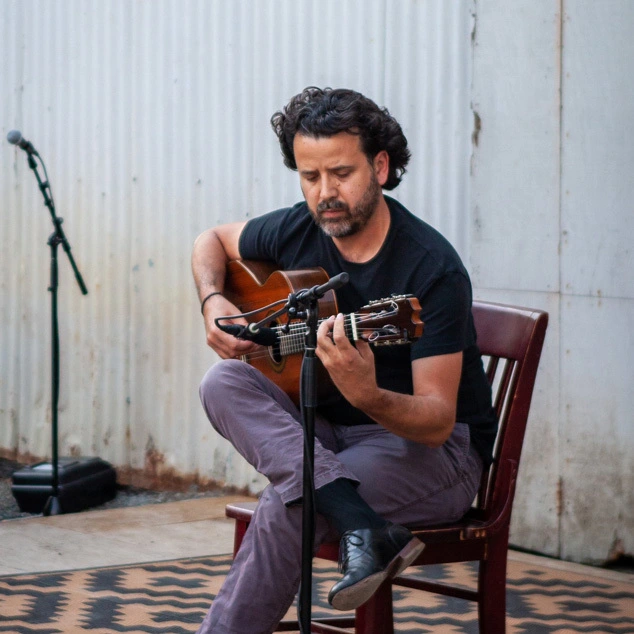
Espasón is designed as a concept album with numerous episodes. The middle section is devoted to cante flamenco or, more specifically, to Cante Jondo (Deep Song). This form of singing occupies a special place within the world of flamenco, and it’s the first time I’ve featured cante on a record. The vocal performance is delivered by a young singer named Edu Hidalgo, originally from Badajoz, who now resides near Sevilla. He’s relatively young, but has an old-soul voice that is ideal for expressing the deep sense of tragedy found within Cante Jondo. Unexpectedly, he’s also a telecommunications engineer, which I find fascinating. He doesn’t conform to the cliches and stereotypes that people often associate with flamenco artists.
There are many things I find powerful about flamenco. I like music that is complex, and that has a raw, forceful type of emotional expression. When I first discovered flamenco, it hit me hard. It’s always moved me in a visceral way. I was also captivated by the dynamic shifts in flamenco. It’s not always fast and forceful. At times it’s gentle and tender, as it projects sorrow, loss, grief, isolation, and other strong emotions. This broad expressive range was something I hadn’t encountered in other styles of music. It became obvious that I could express all my emotions through flamenco, and could spend an entire lifetime learning from it and enjoying it.
How did your Fulbright grant to Spain in 2017/18 inspire Espasón and deepen your understanding of flamenco art and performers?
Fulbright was critical for me. Flamenco is not taught in the vast majority of North America’s music institutions. Flamenco’s culture is rather insular, and it’s a much more grassroots type of music built upon a rich oral tradition. Fulbright embedded me in that community and connected me with artists who would eventually play on Espasón. I affiliated with the Fundación Cristina Heeren de Arte Flamenco in Sevilla for Fulbright. The instrument training I received there improved the way I play guitar, as well. It improved my technique, rhythm, and harmonic understanding. After Fulbright, I stayed another year and studied with Eduardo Rebollar of Artes Escénicas Rebollar. Eduardo specializes in the accompaniment of singing, which was particularly important to me. I made big improvements to my skills as an accompanist during my time with Eduardo. Those were two intense years of work on the guitar. I actually started developing tendonitis in both hands, so I had to scale back my daily routine and do some physical therapy, as well.
I also did an extensive interview project with people in the flamenco community – young artists, living legends, students, luthiers, etc. These conversations were invaluable and I still think about them a lot. My interviewees were surprisingly generous with their time and shared a wealth of information and wisdom with me. This helped me mature as an artist, and it’s something you can hear on Espasón, especially if you compare it to my first album, Punto Lejano. I’m still quite proud of Punto Lejano, because it helped me secure my Fulbright. The work I did there helped put me in a position to be competitive for Fulbright. However, Espasón is a more mature album. It’s a big step forward, artistically, technically, and otherwise.
In terms of deepening my understanding of flamenco, this is a big one. Flamenco has a unique musical language. It really is a language, complete with a vocabulary and grammar all its own. A background in jazz or classical music, for example, does not prepare you for working in a flamenco setting. Flamenco is also a life philosophy and worldview. In order to interpret the music authentically, an artist has to understand the linguistic and philosophical universe of flamenco. Embedding oneself in flamenco culture is the only way to do this, and Fulbright gave me the opportunity to make it happen.
As someone trained in both music and architecture – how do these two disciplines combine to inspire and sustain your work?
The relationship between architecture and music is complex, and is something I’m always thinking about. They’re intertwined on creative, technical, logistical, financial, and philosophical levels. I certainly would not be the musician I am today without my education and career in architecture, and vice versa. Architecture has taught me how to compose, albeit with a different medium. A design education generally begins by teaching principles of abstraction and the fundamentals of concept development. It teaches you how to give form to some very ephemeral, intangible ideas. Of course, architecture is also a physical construction, an assembly of many small pieces and components that come together to form a whole. This whole is not just conceptual either; it has to resist the very real forces of gravity, water, wind, and more. These realities of architecture have taught me to pay close attention to small details. Details are important.
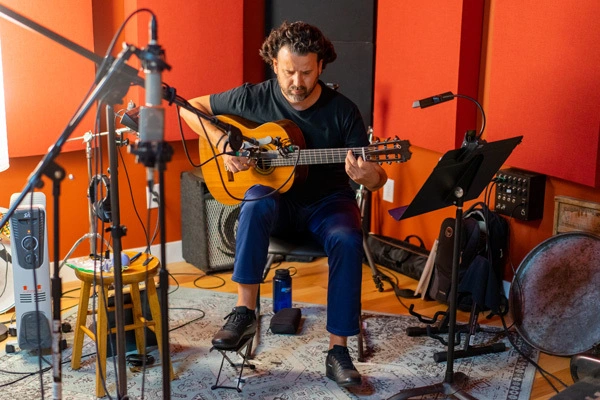
I approach music in similar ways, but obviously the medium is sound, as opposed to space and built form. I develop abstract ideas and concepts that unify disparate elements of music. I’m always thinking about different scales… For example, “How do these three notes relate to the entire album?” I think about how musical structures work, from the micro level to the macro level. Music doesn’t have to deal with actual gravity or keeping the rain out, but without a strong concept and structural cohesion, the musical edifice falls apart.
On a more practical level, my work in architecture provides financial support to my artist practice. Needless to say, it’s difficult to earn a living from music alone. In a niche genre like flamenco, it’s even more difficult. Therefore, my musical work is sustained by my architectural career, by grants and fellowships such as Fulbright, and by a small group of committed fans.
About
Born and raised in Idaho as the son of a Salvadoran immigrant, Gustavo is formally educated in architecture, where he’s earned two degrees. He’s worked as a guitarist for over a decade in Washington, Texas, and Spain, and self-produced a studio album in 2014, Punto Lejano. This helped secure a Fulbright fellowship to Spain in 2017, and provided his only formal musical education. During Fulbright, he trained with top guitarists, conducted an interview project with the broader flamenco community, and prepared future project material. His second album, Espasón, was a collaborative, international project and was released in July of 2023. Shortly after releasing Espasón, he received a composition fellowship by The Helene Wurlitzer Foundation of New Mexico, where he will be an artist-in-residence during summer of 2024. To learn more about Gustavo and to listen to his music, please visit www.studioespason.com.