

Snapshots presents Alex Edmans on 'May Contain Lies: How Stories, Statistics and Studies Exploit Our Biases - And What We Can Do About It'
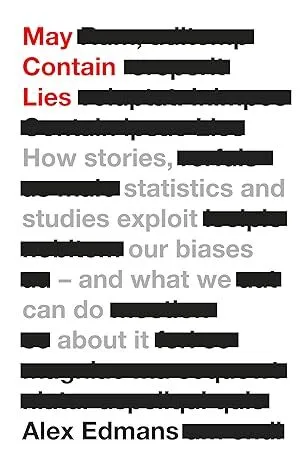
"it was through meeting people with different perspectives, backgrounds, and skills that I learned the value of cognitive diversity, challenging your biases, and questioning what you’d like to be true, and I aimed to convey these learnings into the book."
Could you tell us more about your new book May Contain Lies: How Stories, Statistics, and Studies Exploit Our Biases – And What We Can Do About It?
This book is about misinformation – but with a twist. We often think it’s about checking the facts, but the punchline of the book is that this isn’t enough. Even if the facts are 100% accurate, they may still be misleading, as shown by the Ladder of Misinference below:
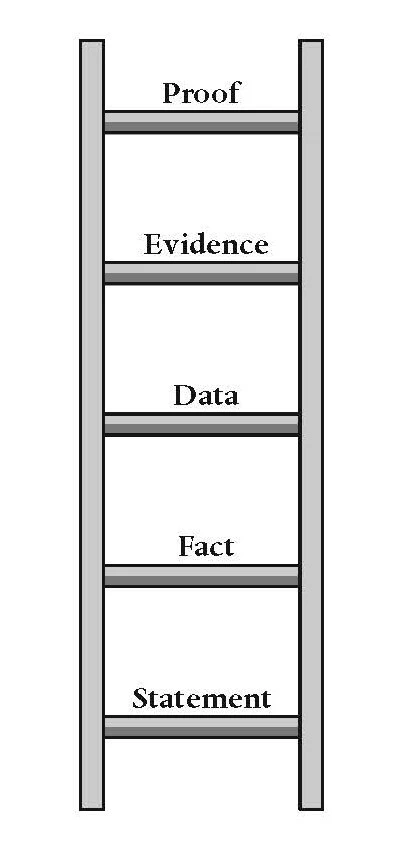
We often focus on the first misstep. We are aware that a statement is not fact as it may not be accurate, and we know to check the facts. But that’s not enough, due to the other missteps in the ladder.
- A fact is not data: it may not be representative if it’s selectively quoted. Someone could trumpet a smoker who lived to 100, but hide the thousands of others who died from their habit. Business school case studies typically take the most extreme example to illustrate a point.
- Data is not evidence: it may not be conclusive if it’s correlation without causation. People who eat whole grains are less likely to have heart disease. But people who choose to eat whole grains may lead healthier lives in general, and this could be causing the lower heart disease, rather than whole grains being a superfood.
- Evidence is not proof: it may not be universal if it’s in a different context. The famous Marshmallow Studies showed that kids who resist eating a marshmallow (to get two later) do better in life. But they focused on Stanford University children. Kids of less wealthy backgrounds might be better off with whatever’s in front of them right now, because they shouldn’t trust that it will be there tomorrow.
My book focuses on these more subtle mistakes, in the spirit of Kahneman’s Thinking, Fast and Slow but applied to information rather than choices. The book covers a range of topics – business, politics, science, health advice, and parenting – and goes beyond thinking smarter as individuals to creating smart-thinking organisations that harness diversity of thought, overcome groupthink and embrace challenge.
With your background as a leading voice on finance and business, can you share more about what inspired you to write May Contain Lies?
While my day job is being a university professor, I’m particularly passionate about applying the insights of academic research to real-world problems, rather than doing research just to be read by other academics. I thus engage extensively with policymakers, companies, investors, and the media and very much enjoy doing so. However, how they respond to research often depends on whether they like its findings, rather than how accurate it is. If it gives them the result they want, it’s the world’s best paper; if it contradicts what they’d like to be true, it’s purely academic and has no relevance for the real world. In addition, practitioners are often swayed by research from companies, even though it typically makes very basic mistakes and its goal is advocacy or marketing rather than scientific inquiry.
People who latch onto findings they like and dismiss those they dislike aren’t doing so deliberately to pursue an ideological agenda. They’re human, and like all humans, they’re prone to biases, and it’s these biases that cause them to err. I wanted to write a book to make readers aware of the biases that cause them to fall for misinformation, and to give them simple tools to combat it – to distinguish between statements, facts, data, evidence, and proof. In particular, I wanted to do so in a clear, non-technical, and sometimes humorous way: a big reason why academic research often has little impact on the real world is we don’t invest the time into making it accessible.
How have your experiences as a Fulbrighter influenced this book?
My experiences as a Fulbrighter taught me the importance of not only taking seriously different viewpoints once I heard them, but actively seeking them out. My Fulbright studies involved amazing cultural enrichment as I lived away from my home country for the very first time, and landed in a place where I knew no-one. But it was through meeting people with different perspectives, backgrounds, and skills that I learned the value of cognitive diversity, challenging your biases, and questioning what you’d like to be true, and I aimed to convey these learnings into the book.
More about Alex
Alex Edmans is Professor of Finance at London Business School. Alex has a PhD from MIT as a Fulbright Scholar, and was previously a tenured professor at Wharton and an investment banker at Morgan Stanley. Alex has spoken at the World Economic Forum in Davos, testified in the UK Parliament, and given the TED talk “What to Trust in a Post-Truth World” and the TEDx talks “The Pie-Growing Mindset” and “The Social Responsibility of Business” with a combined 2.8 million views. He serves as Non-Executive Director of the Investor Forum, on the World Economic Forum’s Global Future Council on Responsible Investing, and on Novo Nordisk’s Sustainability Advisory Council. Alex’s first book, “Grow the Pie: How Great Companies Deliver Both Purpose and Profit”, was a Financial Times Book of the Year. He has won 25 teaching awards at Wharton and LBS and was named Professor of the Year by Poets & Quants in 2021.