
Snapshots presents Ricardo Fabrino Mendonça, Fernando Filgueiras and Virgílio Almeida on 'Algorithmic Institutionalism'
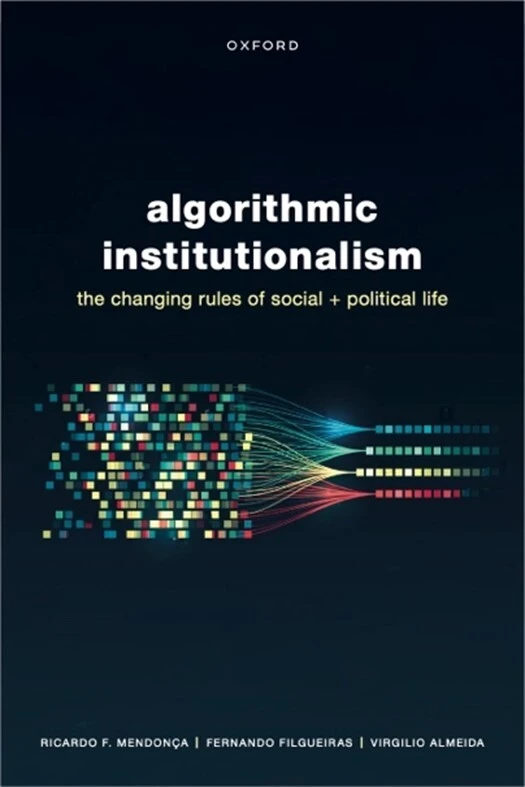
It is necessary to think about how algorithms can be democratized to contain the risks they pose to contemporary societies due to their growing decision-making capacities
1. Could you tell us a little about your book Algorithmic Institutionalism: The Changing Rules of Social and Political Life? What do you see as the importance of democratising algorithms??
The volume addresses the growing presence of algorithms in everyday decisions that impact our lives, and the social and political impacts of this phenomenon. In times of increased attention to the advancement of Artificial Intelligence (AI) and widespread curiosity about the consequences of the automation of various social dynamics, we address complex topics in an accessible and theoretically informed manner, integrating discussions from political science and computer science.
Algorithms promise agile, efficient, and impersonal solutions, taking into account large volumes of data and enabling the rapid allocation of resources. However, various studies show how the boom of algorithms also lead to various problems, from strengthening political polarization to reinforcing prejudices and injustices. It is increasingly clear, for example, how algorithms have reinforced, in different areas, racist views, in what has been named algorithmic racism.
Algorithmic Institutionalism discusses these issues by advancing an innovative argument: it is possible to consider algorithms as emerging institutions in contemporary societies. This is because they operate as sets of rules that help structuring norms and contexts in which humans and machines act. Thus, algorithms influence individual behaviors and have collective consequences on societies. We address these issues by exploring examples of algorithms adopted in public security, government platformization, and the construction of recommendation systems in various fields. Algorithms are structuring new political orders based on a rationalization achieved through computational systems. In a nutshell, we claim that, just as other complex institutions were democratized in the past, it is necessary to think about how algorithms can be democratized to contain the risks they pose to contemporary societies due to their growing decision-making capacities.
2. Algorithmic Institutionalism brings together three authors’ expertise across a range of fields, including computer science, political theory, public policy and communication studies. What, for you, is the value of bringing this cross-disciplinary approach to the study of algorithms?
Complex issues claim for transdisciplinary approaches. One cannot fully understand the social and political impacts of algorithms without cross-disciplinary lenses. The cross-fertilization of different fields can shed light on the technical and political dimensions of these artefacts that we claim to be institutions.
3. How did your respective Fulbright experiences in 2007 and 2019 shape your professional and intellectual development?
Ricardo had the chance to work at the Center for the Study of Democracy, at the University of California Irvine, where he found a lively academic environment and established relevant academic collaborations. The time in Irvine was particularly important to the comprehension of some of the political consequences of technological developments to democracies, which is central to the book. During his visit to the US, he also had the chance to engage with scholars from different parts of the country (including NY and New Orleans) and to experience the American culture daily, which shaped important aspects of his personal views and intellectual perspectives.
Virgilio collaborated with Prof. Keith Ross at NYU in 2007 during his tenure as a Fulbright visiting scholar. An integral aspect of his research at that time was the focus on understanding the impact of computer science issues on the social and political landscape. The collaboration with Prof. Ross yielded numerous outcomes, including one paper that was featured in the New York Times ("Researchers Uncover a Flaw in Europe’s Tough Privacy Rules," NYTimes, June 03, 2016). I assert that the Fulbright visit to NYU played a pivotal role in strengthening a significant research strand in my work.
About
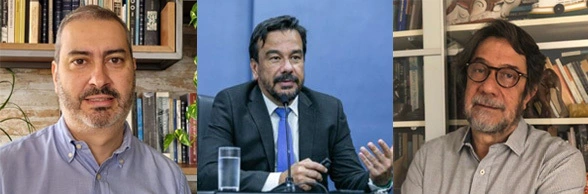
Ricardo F. Mendonça is an associate professor in the Department of Political Science at the Federal University of Minas Gerais (UFMG). He is a researcher at the National Institute of Science and Technology for Digital Democracy and the coordinator of Margem – Research Group on Justice and Democracy. He holds CNPq and Fapemig Fellowships. He was a Fulbright Visiting Scholar at the University of California Irvine (2019) and has also had visiting positions at Centre for Deliberative Democracy and Global Governance (Canberra, Australia). His research interests include: Democratic Theory, Contentious Politics and Political Communication. Twitter (X): @MendoncaRF
Fernando Filgueiras is associate professor at the Faculty of Social Sciences at the Federal University of Goiás (UFG) and a professor at the National School of Public Administration (ENAP). Additionally, he is a researcher at the National Institute of Science and Technology for Digital Democracy and a faculty affiliate of the Ostrom Workshop on Political Theory and Policy Analysis at Indiana University (United States).
Virgílio Almeida is an emeritus professor in the Department of Computer Science at the Federal University of Minas Gerais (UFMG). Virgílio is a member of the Brazilian Academy of Sciences (ABC), the Academy of Sciences for the Developing World (TWAS), and the National Academy of Engineering (ANE). Virgilio is also an Associate Professor at the Berkman Klein Center at Harvard University and holds the Oscar Sala Chair at the Institute of Advanced Studies at USP. Twitter (X): @virgilioalmeida. Google Scholar.