
Snapshots presents Liz Przybylski on 'Sonic Sovereignty: Hip Hop, Indigeneity and Shifting Popular Music Mainstreams'
Indigenous pop musicians and music professionals have worked over the past several decades to use media structures to get heard, and to shape those media structures to their needs. That is a story worth listening to.
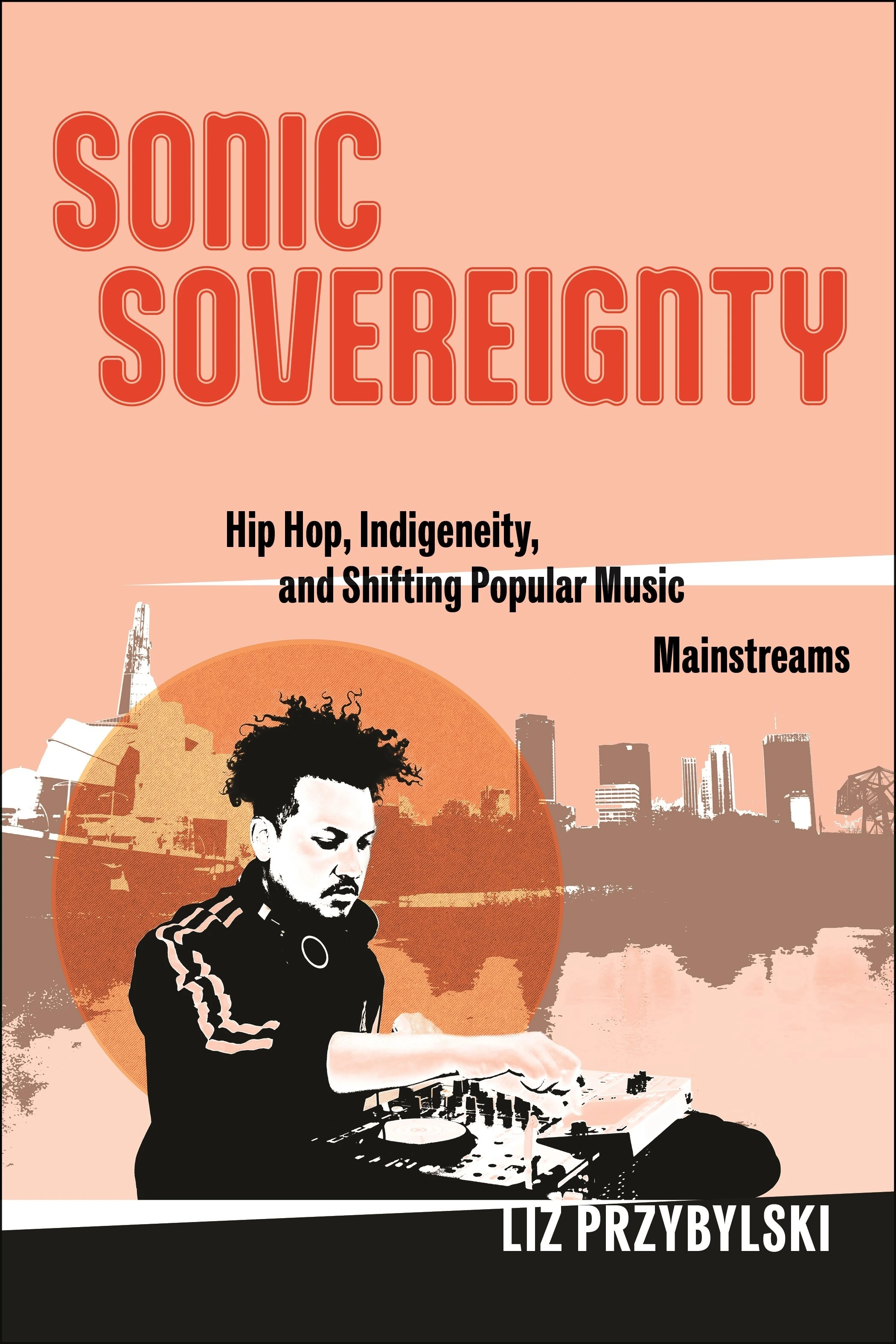
Could you tell us a little about your new monograph Sonic Sovereignty: Hip Hop, Indigeneity and Shifting Popular Music Mainstreams ?
This is a book about listening. Throughout the book, I use the writing to visit and revisit what we might call the “same” music multiple times. I encourage my reader to become a listener, and pay attention in different ways. I do this because hip hop has an amazing way of bringing listeners in and out of time. If you hear a sample, you can experience the memories and associations you have with that music. If you hear a break repeated, your brain, or your body if you’re letting yourself dance along, can get into a kind of a groove, and time loops. Indigenous hip hop amplifies some of these nonlinear time effects. I write in the book about conversations I have had with the musician Leonard Sumner, an Anishinaabe popular musician from the Interlake in Manitoba, Canada. He has talked about how hip hop is a form of storytelling, which has some links to Anishinaabe storytelling. There are a variety of ways to tell stories in music, and a variety of ways to listen.
One way to listen for sovereignty is to listen for the ways artists choose to tell their stories, including using the storytelling techniques they prefer, or sampling the sounds they choose, using the language or languages they want, including Indigenous languages in rapped lyrics. This also includes choosing not to say or sing or share certain things in pop venues, because silence is part of sound and sovereignty.
Another way to listen for sonic sovereignty is to pay attention to the album For Women By Women by Eekwol and T-Rhyme. Eekwol is a Nehiyaw MC working out of Saskatchewan in Canada who first gained popularity in hip hop in the 90s. T-Rhyme is skilled with wordplay and witty references. She is a Nehiyaw and Denisuline MC, also from Saskatchewan. In the book I analyze their album and touring they did for For Women By Women. Their album asks, what would happen if music were made with women in mind and with Indigenous women at the center, and by its very being it also answers those questions. It is helpful to bring a kind of analytical lens, which I do in the book, where we can think about media circulation and alternative publics, and it is also helpful to listen and relisten to For Women By Women to pay attention to how hip hop already contains its own theory.
One of my goals for the book is to spark conversation and action about what media structures are doing for us. How does radio work for listeners and musicians? How does streaming audio work for listeners and musicians? Who is on the radio, who gets played on streaming audio, and how can media professionals, listeners, and musicians work together to get more diverse voices on air? The book brings forward the influence that Indigenous artists have on “mainstream music.” Indigenous pop musicians and music professionals have worked over the past several decades to use media structures to get heard, and to shape those media structures to their needs. That is a story worth listening to.
This book encourages readers to listen to Indigenous hip hop artists and other popular musicians, to get to know new artists, to pay attention again to those you may know, and to go to shows and get their music. That’s why the book release was accompanied by a playlist. I encourage readers to open your ears, pay attention to how you listen, and be ready to listen in different ways.
How did your Fulbright experiences in Canada in 2013 shape your research into expressive culture?
Fulbright supported my research in Winnipeg, Canada in 2013-2014. This was pivotal. It allowed me sustained time to listen and learn with hip hop performers and media professionals in this city, which is home to radio, TV, and festival programs that impact Indigenous media circulation in Canada and across borders. I am grateful to Professor Sherry Farrell-Racette, as well as faculty and students in both the Indigenous Studies and Music faculties at the University of Manitoba, for support and dialogue during my fellowship. It has been exciting to see and participate in the growth in Indigenous popular music studies between when I started research for the book years ago and when I completed the manuscript a little while back: there are so many more scholars and musician-scholars active on the academic side of this today then there were in 2008. Of course, musicians make their own theory through their creative practice, and have been doing so in hip hop since it began. Fulbright helps to connect people and ideas; this ethos extended past my research period and into the years afterwards. Winnipeg continues to be an important media center. Readers can listen and learn from the sākihiwē festival, the Indigenous Music Countdown, the International Indigenous Hip Hop Awards, radio station NCI-FM, broadcaster APTN, the CBC podcast Unreserved, and check out dance and music by Studio 393 artists, among others.
Speaking as an ethnomusicologist, how has your field evolved given recent technological advancements and the ongoing impacts of Covid? What possibilities does a “hybrid” model of ethnography offer?
COVID moved many music scenes and other cultural practices online, or increased the use of online parts of these fieldsites. Some of these continue online or in a hybrid online/offline way, as the world adjusts to new realities. For researchers, this has meant that some people who never planned to do online participant observation have had to learn how to do this quickly. There are some benefits to scholar-participants gaining this kind of flexibility: many scenes have been hybrid (included integrated online and offline aspects) for quite a while, yet research methods have been slow to catch up with this reality. Now, more ethnographers are ready and able to participate across all aspects of a fieldsite, incorporating online and offline and hybrid activity. This helps participant-observation research better reflect the way many participants live: online and offline activities are frequently already interconnected. My writing explores the methodology for others to adapt to their own research projects, as well as sharing information from my research.
About
Dr. Liz Przybylski is a pop music scholar working in hip hop and electronic music in the US and Canada. An Associate Professor of Ethnomusicology at the University of California, Riverside, Liz is the author of Sonic Sovereignty: Hip Hop, Indigeneity and Shifting Popular Music Mainstreams (NYU Press 2023) and Hybrid Ethnography (SAGE, 2020), and an awardee of the National Endowment for the Humanities Faculty Fellowship. Recent publications center on- and off-line hybrid research in hip hop as well as popular music pedagogy, such as the article “Indigenizing the Mainstream: Music Festivals and Indigenous Popular Music” in IASPM Journal (2021). Liz’s writing has appeared in music journalism websites including I Care if you Listen and Artbound. Liz teaches courses on ethnographic methods, popular music, and gender and sexuality studies. On radio, Liz hosted “Continental Drift” on WNUR and conducted interviews for “At The Edge of Canada: Indigenous Research” on CJUM. https://dr-lp.org
Find out more about Sonic Sovereignty by listening to the playlist and reading the accompanying blogpost.