
Snapshots presents Rebecca Schmid on 'Weill, Blitzstein, and Bernstein'
Part of the Fulbright experience is taking part in the trans-Atlantic dialogue that has been essential to academia in many countries since the mid-twentieth century – not least musicology.
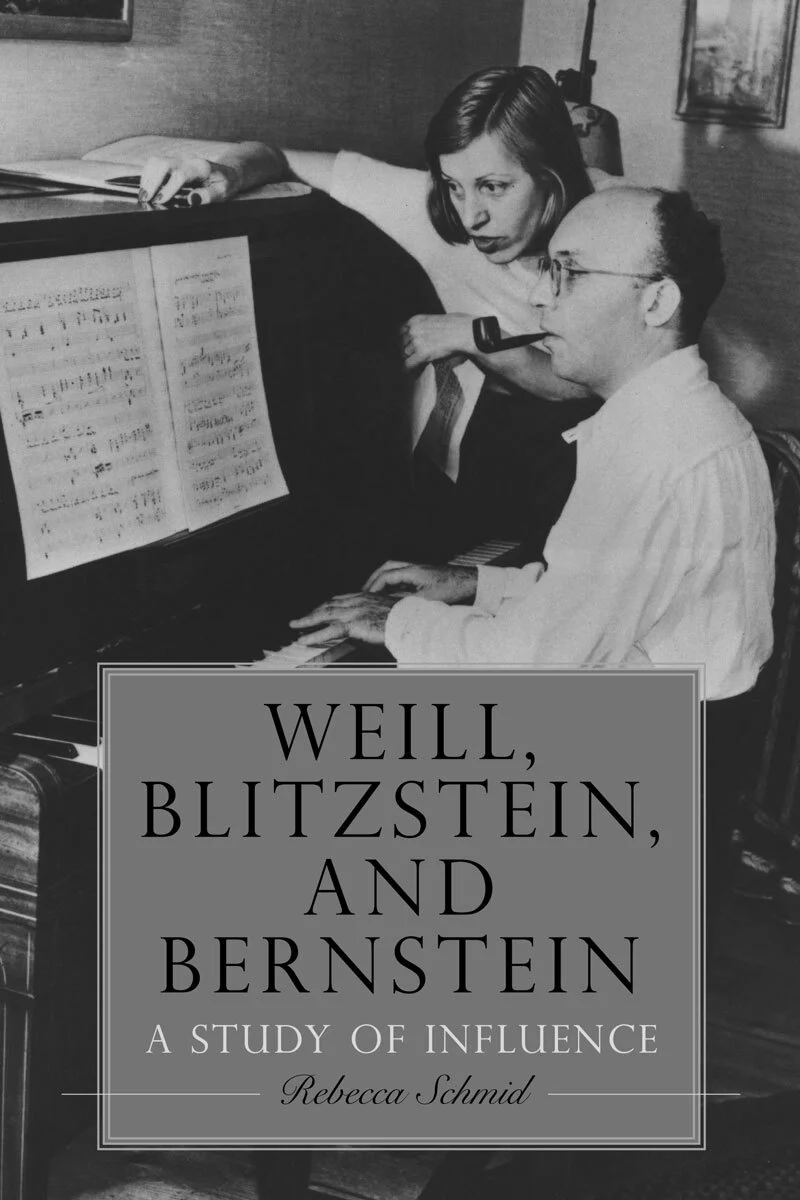
Could you tell us a little about your new monograph Weill, Blitzstein, and Bernstein: A Study of Influence?
My book explores how Kurt Weill's stage works set an inescapable precedent for the operas and musicals of Marc Blitzstein and Leonard Bernstein although both composers resisted or downplayed his contribution to American tradition. I chose works that represent different phases of Weill's mission to renew the genre of opera, evolving from Die Dreigroschenoper to Lady in the Dark and Street Scene. I then draw comparisons to scores by Blitzstein and Bernstein – The Cradle Will Rock, Regina, Trouble in Tahiti, Candide, and West Side Story – exploring formal constructions but also making observations on melodic, harmonic and dramaturgical elements. I further include the unfinished work A Pray by Blecht, for which Bernstein re-joined Stephen Sondheim and Jerome Robbins, his collaborators on West Side Story.
Weill’s influence had been covered in passing but had yet to be the subject of a detailed study. It is only in recent years that scholarship has allowed for recognition of a certain continuity between his American period (1936-1950) and the musico-dramaturgical principles he championed in Weimar Germany. There was also the challenge of isolating elements in Weill’s scores that provide the basis for tracing his impact on American music theater. Weill of course also created in the wake of other composers – Bach, Mozart, Verdi, Stravinsky – and yet he always acknowledged his influences. My study explores the creative process when a composer does not necessarily do so.
How did your experiences as a Fulbrighter to the US in 2001 shape your artistic practice?
Thanks to the invitation to do research in Vienna, I had the opportunity to study archival material straight out of college. I was also able to attend first-class concerts and operatic performances on a regular basis. In perhaps no other city is classical music so omnipresent. It felt perfectly natural to study an 18th-century manuscript and then hop across the street to the opera. At the University of Vienna, where my mentor was the Mozart scholar Gernot Gruber, I was able to perfect my written German, something which serves me well until this day: My book takes into account English- and German-speaking literature in equal measure.
Part of the Fulbright experience is taking part in the trans-Atlantic dialogue that has been essential to academia in many countries since the mid-twentieth century – not least musicology. As we know, this narrative has been challenged in recent times, and I consider it a responsibility to draw upon the perspective I have as a Swiss-American (born in France) who has lived and studied in both Europe and the U.S. My take on Weill’s career certainly reflects the premise that his music transcends considerations of national identity – that it was perfectly natural for him to emigrate across the pond and continue to develop his compositional principles further, even though he was writing for a very different audience.
I in fact wrote most of the book in Berlin, where I completed my PhD as a student at the Humboldt University. It is thanks to the Fulbright program that I met the musicologist Wolfgang Rathert and subsequently my supervisor, Arne Stollberg. I am now back in Vienna, where I have been researching the city’s 20th-century history for an upcoming publication. It is always a privilege to study a subject matter on-site – and the Fulbright program very much paved the way for me to take on such projects.
Your website opens with a quote from Bernstein: “Music, of all the arts, stands in a special region, unlit by any star but its own, and utterly without meaning ... except its own.” As both a performer and a researcher – what for you is so powerful about music?
Classical music has had an unavoidable power over me since I was a young child. For many artists over the course of history, there is no other genre that opens so many dimensions: imaginative, spiritual, philosophical. Of course, composers could not create without staying in dialogue with the literature, dance and visual art of their time. But writers such as Goethe or Schopenhauer acknowledged music to the be the highest of art forms.
Music, and in particular classical music, engages a person’s intellect and body with a strength like nothing else. It is a discipline which requires consequent dedication over a period of many years. And it speaks a language that transcends linguistic, temporal or cultural boundaries. I think this is what Bernstein means in this quote. He very much believed in the power of music to unite mankind – whether conducting Beethoven’s Ninth Symphony upon the fall of Berlin Wall or writing West Side Story.
Bernstein of course struggled to fulfill his idealist visions as his career moved between concert halls, the television studio, opera houses and Broadway. But he found a way to make classical music accessible to a mainstream audience, through his Young People’s Concerts and in other public appearances. He also succeeded at melding the language of European opera and the American musical in his compositions, as I discuss in my book.
About
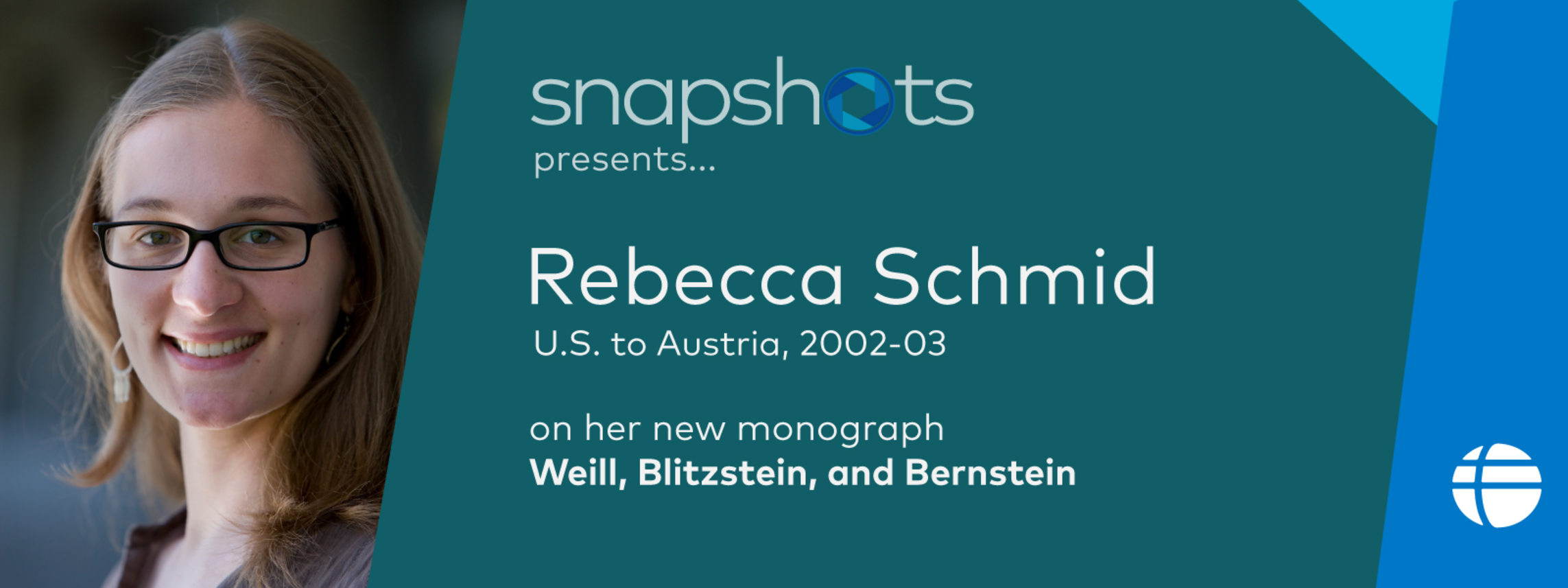
Rebecca Schmid, PhD, is an independent scholar, music writer and culture journalist based in Vienna. Her book Weill, Blitzstein, and Bernstein: A Study of Influence appears June 20 on University of Rochester Press/Boydell & Brewer. Related publications are also forthcoming this year on Cambridge University Press. Rebecca has moderated and written program notes for such organizations as the Salzburg Festival, Cleveland Orchestra, Metropolitan Opera and Verbier Festival. Her reviews and features have appeared in the Financial Times, New York Times, Das Orchester, Berliner Morgenpost, Gramophone, Opernwelt and many other publications.