
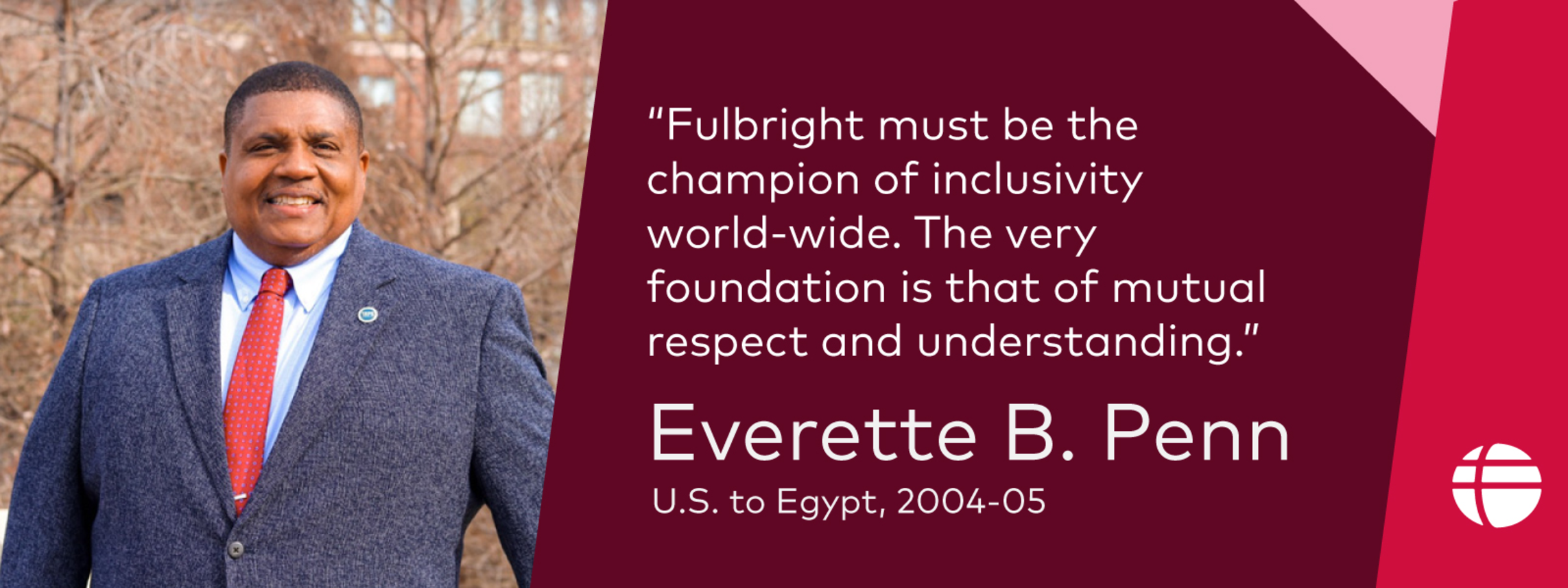
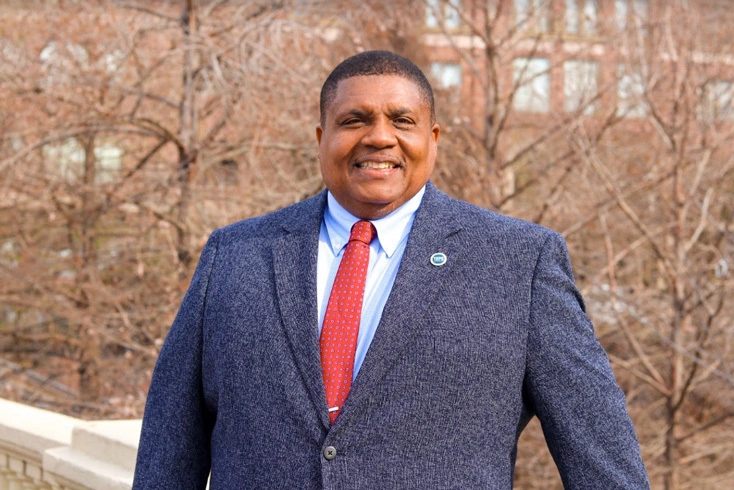
Black History Month: Everette B. Penn (U.S. to Egypt, 2004-05)
I challenge the reader to research Black History and Black Firsts to see that many of the items you use daily came from Black men and women.
What have you been doing since your Fulbright award?
It is hard to believe that I am approaching my 20th year since being honored as a Fulbright. Before, during and after my Fulbright to Egypt I had and have woven experiential learning into my career. Before my Fulbright I was an AmeriCorp, Volunteer In Service to America (VISTA), developing sustainable social and educational services for newcomers to the United States. It was my service as a United States Army Officer during September 11th 2001 that inspired my Fulbright to Egypt as I desired to reduce the social distance between the people of the United States and those from the Middle East. I was able to do that through interaction, active listening and developing friendships in which we all discovered we had more commonality than social distance; we had more bonding than breakage, and more opportunity than obstacles. I carried what I learned from my time at Cairo University teaching the American Criminal Justice system back to the United States and for the following 6 years I advocated for the reduction of social distance to the point of making 6 consecutive educational trips with students and faculty to Egypt and co-founding the Teen And Police Service Academy, which works to reduce the social distance between youth and police. It was my conceptual application of my Fulbright in Egypt that allowed me to have insight to turn visions into reality upon applying lessons learned as a Fulbright.
What does Black History Month mean to you?
Move month to daily as our social reality provides us with our perception of a word and its meaning. If one is not careful the term "Black" could provide this veil of negative or being "less than". Hence the Black Lives Matter movement. It is a rally to move Black lives to be on level or par with others. Black History month provides a focus allowing peoples to learn, explore and recognize Black people and their accomplishments. Just yesterday I was helping to set-up a Black History Month display at my son's high school and found it fascinating to discover the hundreds of inventions, firsts and accomplishments of Blacks. I challenge the reader to research Black History and Black Firsts to see that many of the items you use daily came from Black men and women.
How do you think Fulbright can be more inclusive?
Fulbright must be the champion of inclusivity world-wide. The very foundation is that of mutual respect and understanding. There is the challenge. We the exported Fulbrighters cannot be the champion of exporting thought and practice upon our newfound colleagues, friends and people. This practice can become dangerously close to colonization. Instead, let us learn from each other, work together and synergize for success by including all as equal members at the Fulbright table.