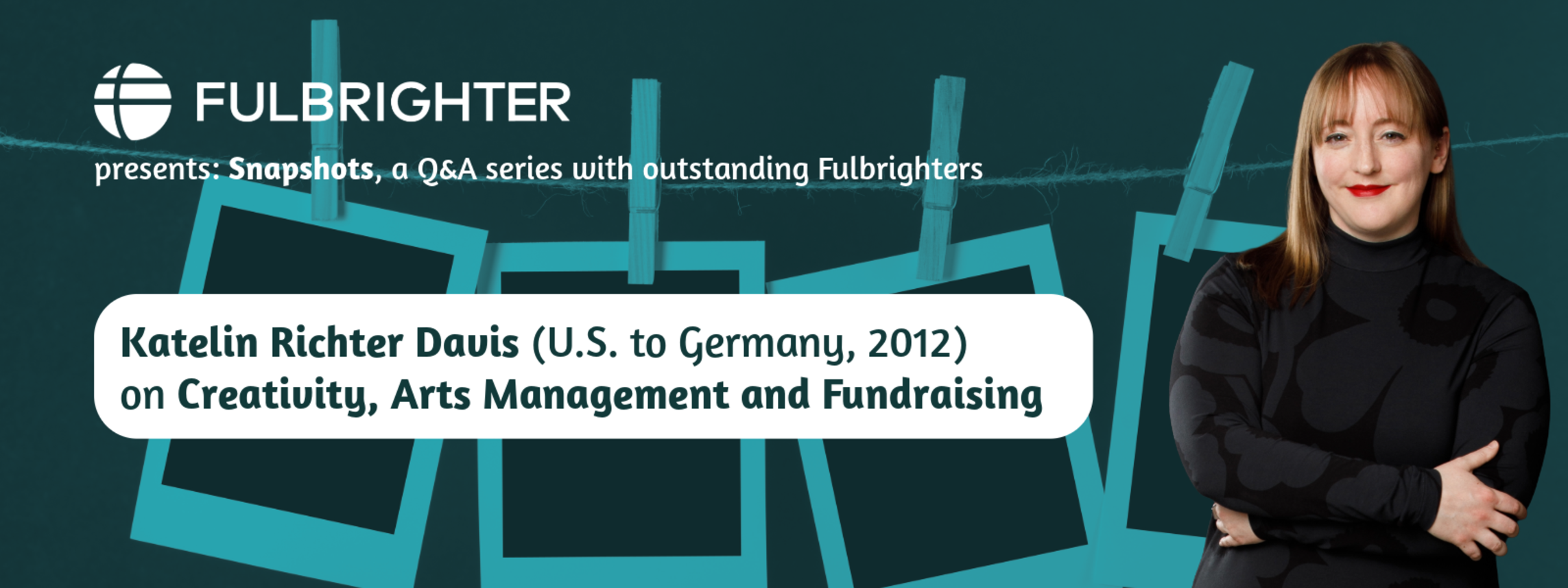
Katelin Richter Davis on Creativity, Arts Management and Fundraising
During her Fulbright grant in Germany, Katelin Richter Davis, focused on cross-cultural exchange of management practices to address contemporary issues in arts management. Since Fulbright, she's applied her research and learning in this field through leadership positions in arts and cultural management and revenue development.
In 2024, she launched her own consulting firm that supports purpose-driven leaders in translating their visions into action, working with clients across the arts and culture sector and public media, as well as mission-driven founders.
In this Q&A, she dicusses creativity, management, pursuing multiple interests and the best practices in fundraising.
You have gone to music school, only to realize you were more interested in how music can create connection than in making music itself. Can you tell us a little bit about how that discovery came about?
My shift to a career in arts and cultural management was catalyzed by interdisciplinary exploration. As I dove into music school, it quickly affirmed for me that I loved music and still wanted to develop my performance skills in a serious way, but also wanted to have other facets to my future career that fed my curiosity.
This led me to an internship in arts management. As a sophomore in college, I was a summer intern at the Santa Barbara Symphony and helped to design and implement a marketing plan for a special concert. When concert day finally came, it was so gratifying to see the hall filled with community and energy. At that moment, I realized that strengthening the organizations that support art-making and artists was a fascinating opportunity for me to continue my love of the arts while weaving together business, strategy and more. To me, this was just as satisfying as making music.
From there, I set out to learn more and more about arts and cultural management, and that eventually led me to Fulbright.
When did you first hear about Fulbright and how did you make the decision to apply?
I first heard about Fulbright through my older sister when I was a senior in high school. My sister has had an amazing career in political science, international policy and diplomacy, and her interest in and respect for the program piqued my own.
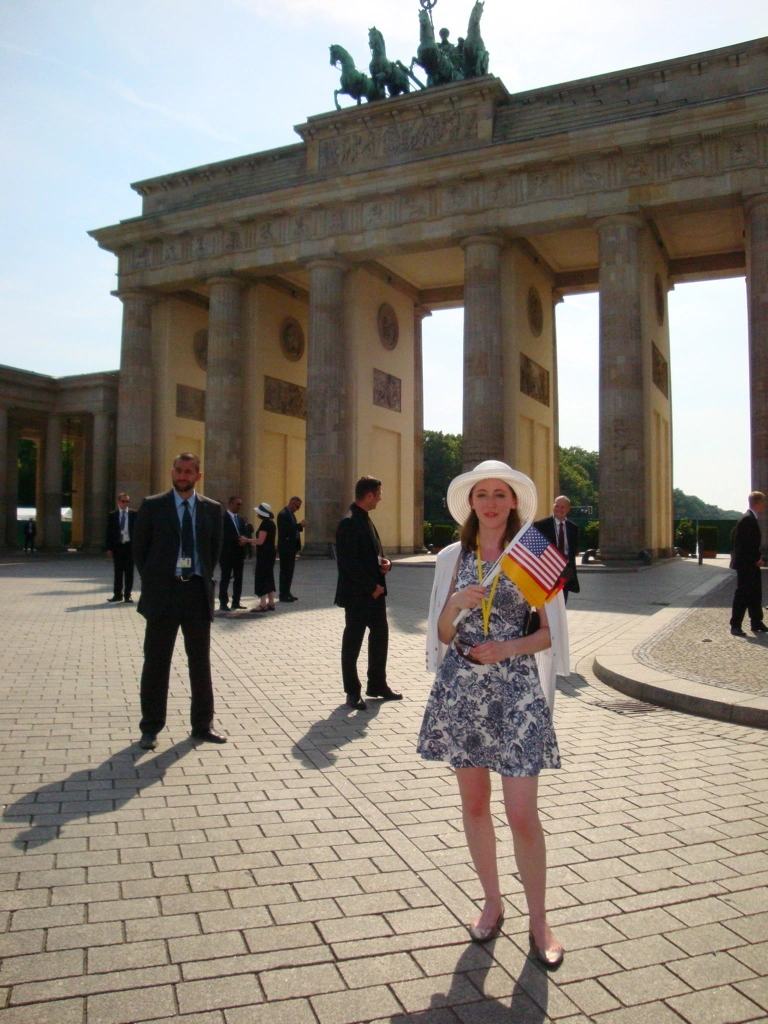
Fast forward to college, I pursued German as one of my majors, and during the summers completed multiple internships in Germany, first with a classical music festival in Mecklenburg-Vorpommern, and then at the U.S. Consulate General Munich. These experiences were catalytic for my personal and professional growth, and I knew that I wanted to go back. Fulbright was an amazing opportunity to continue my learning journey and to spend more time in a country I had come to love.
In 2012 I started my Fulbright research grant in the Business/Management category, studying theater and orchestra management at the music conservatory in Frankfurt am Main Germany.
During your Fulbright Award in Germany, you were researching cross cultural exchange of arts management practices and how it can support the arts management field. What can you tell us about this field and why do you believe culture exchange is so important for professionals in this area?
Cross cultural exchange has so much value. (Of course as a Fulbrighter, I’m biased!) Regardless of profession, I believe that exchange can help lift us up out of our own environment and assumptions to access new perspectives. This can lead to new insights and creative solutions.
Second, knowledge exchange is a form of valuable mutual aid. One thing I have loved about working in the arts and culture sector (and the nonprofit sector more generally) is the goodwill and openness of the people who power this sector. Nonprofits tend to do a lot with a little – lean staff and budgets. While these challenges are reflective of larger systemic issues the sector faces, one powerful way we can support each other is through mutual aid and exchange of knowledge and information. It’s rooted in the idea that we all do better when we all do better.
In addition, Germany represented a unique place to focus on cross cultural exchange of management practices specifically in the orchestra field: the country has one of the densest orchestral landscapes in the world. But similar to the orchestra industry in the United States, it is subject to pressures inherent to the business model of being an orchestra that can present challenges to sustainability. Through my Fulbright I was able to explore how German arts management leaders were approaching solutions to challenges we also face in the United States, and to share what I knew about U.S.-based solutions. This exploration was rich and anything but straightforward; it unlocked new perspectives for me on the role of art in society and, through contrast, prompted me to reflect on the societal context of my work in the United States.
What role do you believe art has in our societies?
For me it’s hard to separate art and society, because I believe art-making and creative expression are core to who we are as human beings. It’s part and parcel of who we are as humans, and therefore of our societies.
I have built my career in the creative sector supporting organizations and art-makers because I believe that creative visions for a better world are deeply needed. After all, how will we create a new and better world if we can’t imagine it first?
Artists have this amazing superpower to help us see the world in new ways. When we talk about the need for innovation, creative problem-solving, and evolution and change, art-making can help us to grasp new possibilities.
You are also focusing on nonprofit revenue development. What are the main things people have to have in mind when trying to raise funds for their nonprofit work, be it in arts or in other areas?
To give a consultant answer: it depends! I always dig in with clients to understand their unique situation before offering advice. Here are a few more general thoughts about my experiences as a fundraiser in the United States:
Question everything: Whether you’re new to fundraising or a veteran of many years, I hope you’ll have the courage to ask lots of questions. To build a more equitable, just and inclusive sector, it’s necessary to question “the way things have always been done” and to determine how we can eradicate practices that perpetuate historical inequities. This is also a powerful way to unlock innovation and creativity: it creates space for new ideas and gives us permission to let go to grow and evolve.
Fundraising isn't a solo effort: While fundraising has become its own specialized profession, I think it’s key to realize that everyone in an organization plays a role in fundraising success. Community support is a dividend of living out public value – that is, fundraising success is highly dependent on everything “upstream” from it, whether its organizational culture, programming, clarity of vision and mission, community engagement, and more.
Connect with others: There are very real structural inequities in our society that can keep nonprofits dramatically under-resourced for the important contributions they make to our shared world. In the face of rising costs, this can create a burnout situation for fundraisers, where you’re constantly challenged to produce more with the same or fewer resources. Holding the fact that this is not okay – nor is it sustainable – please know that you are not alone. One of the wonderful things I’ve experienced in my own career is the culture of mutual aid, openness and support among people in the sector. If you’re struggling with a question, not sure what to do next, or just need someone to be your cheerleader in a difficult time, reach out to someone (including me! www.krd.llc). We can support each other.
In your current role as a consultant you mention how creativity is one of the driving forces in your work. How do you think we can make sure we’re feeding our creative sides?
I’m about to use a buzzword: self-care! For me it’s been a real necessity to tend to this. As a super driven person I can get lost in whatever exciting project has captured my attention. But there is tons of brain research out there showing that rest is necessary to recharge your brain and fuel creativity. Get your rest, folks!
I also think that exploration, indulging your own curiosity and seeking out novelty is huge. Whether it’s taking a trip somewhere new, spending a day at an art museum, or diving deep into a new research rabbit hole that catches your fascination, it can be a way to joyfully gather a breadth and depth of learnings that you can later recombine in new ways and contexts. There is a definition of innovation that has always resonated with me: innovation comes from synthesizing and recombining existing ideas and concepts in new and valuable ways. Creating inputs to the creative process by exploring and gathering is important.
Last but certainly not least, mindset is critical. I think a lot of us carry internal narratives that are really the reflection of others’ voices, not our own – whether it was someone who told you as a child that you weren’t good at writing poetry, or when you took flak for trying something new at work that failed. In my opinion, a bias for action and iteration is key to creativity. Letting go of the fear of judgement (either from ourselves or others) is hard – we’re human! Being able to objectively analyze and sort through the internal narratives we tell ourselves, so that we can dismiss those that keep us small, is important to creating. It’s a constant reframe that has helped me to push myself to new growth horizons.
I have a little graphic on the homescreen of my laptop that is a logic flow chart: “I want to do this” → “But I’m scared” → “Do it scared.” It helps.
Many people see arts organizations primarily as creative institutions. What management challenges do they face behind the scenes that people are often not hearing about?
In the 1960s, American economists William J. Baumol and William G. Bowen published a seminal study called Performing Arts: The Economic Dilemma, in which they examined issues common to music, theater, opera and dance organizations in the United States and demonstrated how subsidy of these organizations would be necessary for them to thrive. They also coined the theory of the “cost disease” which sought to explain the dilemma that people-centered professions with low productivity growth face as productivity in other sectors of the economy grows.
Now, what I just said might sound like a lot of Econ jargon – and a “disease” sounds terrible! Let me explain how it relates to arts organizations with an example Baumol and Bowen made famous.
“The number of musicians and the amount of time needed to play a Beethoven string quartet for a live audience hasn’t changed in centuries, yet today’s musicians make more than Beethoven-era wages. [Baumol and Bowen] argued that because the quartet needs its four musicians as much as a semiconductor company needs assembly workers, the group must raise wages to keep talent — to keep its cellist from chucking a career in music and going into a better-paying job instead.” (Citation)
But wait. Why not sell more tickets or more expensive tickets, or grow the audience? Well, these solutions all carry trade-offs. Selling more tickets in a fixed venue requires adding performances, which can actually increase the subsidies needed and drive up marketing costs to fill more seats. Raising ticket prices risks can crowd out audiences, directly undermining a nonprofit's responsibility to serve the public. Growing audiences, through digital media for example, can come with significant costs, and driving enough scale is hard for even the biggest players.
So, this issue is essentially core to the business model, and must be addressed in an ongoing way by public subsidy and philanthropy. With rising costs and volatility in public funding in the United States, there’s constant pressure to grow philanthropy – which you can imagine, is difficult for even the most well-resourced organizations.
Headline: Support your local arts organizations.
It is very common nowadays to see people who hold multiple talents and interests feeling like they must specialize in one thing in order to succeed. Your career has allowed you to play around with different interests and, in a way, combine them into the work you currently do. What advice do you have for people who have different interests and are unsure about how to combine them professionally?
The pressure to specialize is very real. Here are a few insights from how I’ve built an aligned career as a multipassionate:
Invest in your own self-understanding. You are your greatest asset. For many years in my career, I knew something didn’t feel quite right, but never made the investment in myself to really understand why. That changed when I made the decision to work with amazing career coaches. As someone who was feeling increasingly confined by a specialist career path, I needed to do the work to develop my own heuristic for career decisions, rather than rely on what conventional wisdom described as moving up the ladder and career success. It turns out that how I work is a lot more important to me than what I am doing, and being able to pinpoint that was essential to guiding my future career decisions.
Treat jobs as data-gathering. Trying new things and taking on projects, jobs or roles is really the only way to gather data on what you like – and equally as important, what you don’t like. Thinking of career steps as data-gathering experiments also totally subverts the idea of trying to find the “perfect job”, which can feel daunting – and especially as a multipassionate, totally out of step with your identity, as you don’t fit comfortably into any single job or role label.
Your genre-spanning abilities are your superpower. Not everyone works in the way you do. In a society that likes to have neat labels and categories for people and careers, hold tight to the fact that you are unique in your ability to span and flex, to consider situations from novel angles, to think divergently, and to catalyze change. Embrace this and work to find succinct ways to describe your unique value to others.
Your website says you help people translate their visions into action. How do you go about the process of taking an abstract idea and shaping it to become an actionable item?
Simply put, I complement my clients’ unique wisdom and skills with my own. It’s a partnership.
My strategic advisory and consulting approach is highly co-creative. Clients come to the table with incredible expertise in their own domain, and often what they need is a partner who can complement them by providing a sounding board, clarity, critical questioning, subject matter expertise, and a framework for making decisions. For me, the process itself looks like a lot of intentional questioning and conversation, research and data-analysis, and structure and process design.
How would you describe your experience as a Fulbrighter in Germany? What were the most surprising aspects of it?
Fulbright was one of the most memorable experiences of my life. What was perhaps most surprising is that I learned so much about myself. Building a life and relationships in a new context is such a powerful way to hold a mirror up to assumptions, beliefs, and ways of thinking that you might take for granted. By immersing myself in a different cultural context and really investing in that experience, it was a powerful way for me to gain a new understanding of myself and what it means to be an American.
What is your favorite thing about Germany?
I treasure my time in Germany in many ways – the opportunities for learning, cultural experiences, and so much more.
But above all I would say my friends. A loving shout out to my classmates at the music conservatory in Frankfurt am Main and others I met during my Fulbright year for their wonderful friendships, many of which have transcended borders and the years since my Fulbright grant.
As the Fulbright Award season is currently open, what would you say to someone considering applying for a Fulbright Award abroad?
I would be remiss if I did not acknowledge the serious challenges that the program faces, which may introduce a lot of uncertainty for Fulbright applicants right now.
At the same time, I believe international exchange based on curiosity, openness, and mutual respect is critically important. As a Fulbrighter, you get to take on the role of a citizen diplomat. In the moment we find ourselves, I believe that Fulbright exchange is an incredibly powerful counter to division and polarization. A Fulbright award represents the chance to not only grow personally and professionally through an exchange experience, but to cultivate authentic connection, mutual respect and cultural understanding in our global society.