
Anton Zeilinger: Fulbrighter 1976–77 and Nobel Prize Laureate 2022
Fulbrighter Anton Zeilinger (Austria to the U.S., 1976/77) was the joint winner of the 2022 Nobel Prize in Physics. In this article, Jacek Aleksander Gruca (a current Fulbrighter at Columbia University) and Marek Żukowski (a frequent collaborator of Professor Zeilinger) reflect on Anton Zeilinger's Nobel prize-winning work and the role of international exchange in fostering groundbreaking experiments.
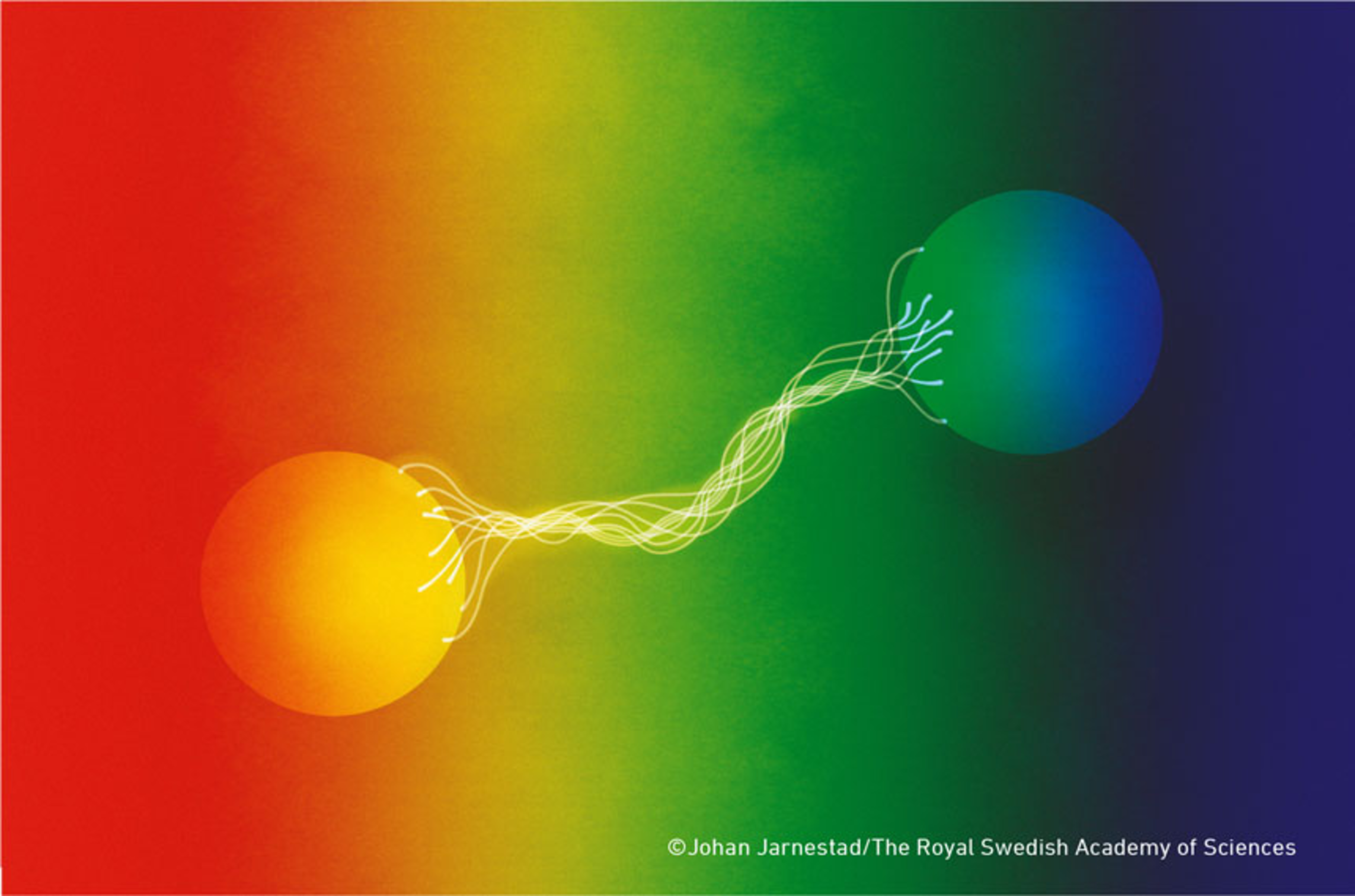
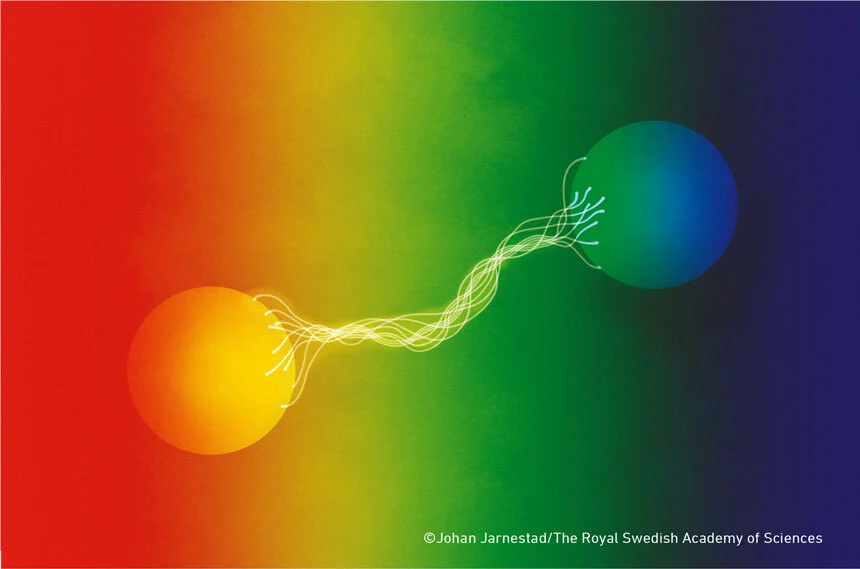
This year's prize winners were recognised for their pioneering work in the field of quantum entanglement. Entanglement - how two or more particles can exist in a shared state, regardless of how far apart they are - is driving significant new research in the fields of quantum computers, quantum networks and secure quantum encrypted communication.
The Nobel Prize for Physics
Marek Żukowski: To cite, the Nobel Prize was awarded "for experiments with entangled photons, establishing the violation of Bell inequalities and pioneering quantum information science." It was shared by:
- John F. Clauser, who co-authored the first paper presenting an experimentally testable Bell inequality and suggested a feasible experiment. Three years later he performed the experiment, which, to his surprise, worked as the quantum theory predicted.
- Alain Aspect, who in 1980-1982 realized much more precise experiments (based on Clauser et al.’s ideas), which shocked some physicists and philosophers.
- And Anton Zeilinger, who expanded the field of studies of quantum entanglement to more than two particles and performed the first quantum teleportation. He also realized demonstrations of feasibility of some of the ideas emerging in the newly born quantum information science, such as quantum cryptography, quantum random number generation, “dense coding" and very many others.
The significance of Professor Zeilinger's work
In one of his experiments Anton transmitted his own €3000 to a bank using a perfectly safe quantum cryptography link
Marek Żukowski: Anton’s work demonstrated that when we study entanglement of more than two particles theoretically and experimentally, we’re charting a fascinating new territory of non-classical effects.
His tests of the feasibility of some quantum informational protocols may lead to a new era of quantum technologies. Such technologies utilize devices which use often paradoxical predictions of quantum theory in order to perform tasks which are impossible with classical devices. Impossible even with devices, such as transistors or lasers, which work only thanks to quantum physics, but perform classically defined tasks. For example, the transistor was invented thanks to deep understanding of the quantum solid-state physics of semiconductors. But it is just a switch, with the following operation modes: “on” (let the current through), “off” (stop the current).
In quantum cryptography, one uses quantum complementarity or quantum entanglement, which exhibit features impossible in the classical realm, to make possible the on-demand creation of two identical sequences of random bits of arbitrary length at two ends on a communication link. There is no way for an eavesdropper, operating in the middle, to get useful information about the encryption sequence. Such sequences can then be used in cryptographic coding, e.g. in the unbreakable Vernam one-time-pad code. Vernam’s code is perfect, but it requires a constant supply of random bit sequences, as long as the message, to be transmitted. This is classically impossible, but quantumly feasible. In one of his experiments Anton transmitted his own €3000 to a bank using a perfectly safe quantum cryptography link.
The philosophical consequences of Anton’s work are very deep. Anton loves Bohr’s dictum that our theories do not tell us how the World is but touch upon what we can say about the World. He was one of the first to announce a successful loophole-free Bell experiment in 2015 (scooped by a couple weeks by a Dutch group.) This implies that Nature follows Peres’ dictum "unperformed experiments have no results." One cannot build a theory which satisfies basic causality principles of relativity (no influences faster than light) and has in its structure results of unperformed experiments (measurements.) When a photon passes via a polarization analyzer selecting, say, vertical polarization, we are not allowed to even think of a result of an alternative unperformed experiment with the same photon and analyzer rotated by 45 degrees. It is not merely unknown, but does not exist even in theory. Anton tries to solve this mystery by postulating that a photon can carry in its polarization degree of freedom only one bit of information. However, this is a hypothesis which goes beyond the achievement for which Anton was awarded the Prize.
The influence of Anton Zeilinger
A lot of his thought on the philosophical consequences of quantum theory inspire me daily.
Marek Żukowski: Well, I’m one of the happy few who can say that Anton’s work influenced me, but also my work and my collaboration with him influenced him. In 1990, after hearing his talk at a conference in Finland I realized that there was much to achieve in the research of quantum foundations and optical quantum interferometry. His talk concerned three-or-more-particle entanglement. During the quarter of a century after the Bell’s paper, which showed non-classicality of two particle correlations, basically nobody asked the following question: if with Bell’s theorem we went from two to three particles, or more, what would we find? This was the step taken by Greenberger, Horne and Zeilinger (GHZ) in 1989, and presented by Anton at the conference. A big shock for me.
The next shock came a year later when Anton invited me to Innsbruck as a visiting professor. This was the beginning of a very intense three decades. We discussed a lot in the first year of my visiting professorship, and subsequently over the next years built the theory of new mulitiphoton experiments. The ideas were successfully tested experimentally in the late 1990’s by Anton’s experimental group in the teleportation, entanglement-swapping and GHZ correlation experiments.
When Jacek was my master’s student, we made numerical studies of “higher-dimensional” entanglement effects; these effects had been suggested as an interesting avenue of work by Anton in October 1991 during our first Innsbruck discussion. Also, Anton’s participation in the creation of the Institute for Quantum Optics and Quantum Information was an inspiration for me to attempt to create in Gdansk a kind of sister institution, the International Centre for Theory of Quantum Technologies (ICTQT). A lot of his thought on the philosophical consequences of quantum theory inspire me daily.
The importance of international exchange
This exchange of thoughts, ideas and contributions is now as important as ever and is exactly what happens during international exchange
Jacek Aleksander Gruca: Groundbreaking achievements almost always happen when there’s a discussion, an exchange of thoughts, ideas and contributions. This was certainly the case during Professor Zeilinger’s Fulbright Fellowship at the Massachusetts Institute of Technology in 1976–77.
As he states himself, his interest in everything quantum began after his arrival in MIT, when he read for the first time the so-called "EPR paradox" paper. In this paper, Einstein, Podolsky and Rosen challenge quantum mechanics as an incomplete theory. But was it really incomplete? Pondering this question led professor Zeilinger to a long journey of discoveries, which resulted in his getting awarded the Nobel prize, surely a groundbreaking achievement.
I think that this exchange of thoughts, ideas and contributions is now as important as ever and is exactly what happens during international exchange, for example during the Fulbright Program. I am currently on a Fulbright Senior Award at Columbia University in the city of New York. I feel encouraged to share my ideas during weekly presentations and to comment on other people’s ideas. Our group is multinational and multicultural and my stay in this group certainly qualifies as international exchange. Of course, I can only dream of my Fulbright exchange leading me to such fruitful areas as professor Zeilinger’s. But regardless of the results, I already feel enriched by this experience, of which not even a half has passed. I am looking forward to more!
I believe that the way to go forward is to establish standards of international exchange, which would encourage researchers to participate in it on a regular basis. This international exchange could serve as a "brainstorming" phase of the research, which could later be followed up on at the respective home institutions. International exchange doesn’t have to be a long stay overseas (although, as in my case, can be). Instead, it can be understood more as a kind of a spirit, shared by two or more parties with various backgrounds, who benefit one another with their thoughts, ideas, perspectives and share common achievements.
Biographies
 Jacek Aleksander Gruca, PhD
Jacek graduated from a Jesuit High School in Gdynia and enrolled as a student of Computer Science at the University of Gdansk in 2003. He showed interest in interdisciplinary research already during his master’s. When Marek presented a computational problem related to Bell inequalities during a guest seminar of Jacek’s master’s course, the latter caught on and two years later graduated as a Master of Computer Science discussing that very problem during his defense. He has since graduated as a PhD of Computer Science from the Institute of Theoretical and Applied Informatics, Polish Academy of Sciences in September 2019. Having completed a postdoc at the University of Gdansk, he is currently pursuing a Fulbright Senior Award at Columbia University in the city of New York under the supervision of professor Qiang Du. The focus of this research lies within Bell inequalities, optimization and artificial intelligence.
 Professor Marek Żukowski
Marek was born in Gdynia, where he attended High-School No 3. When he passed his SAT ("matura") it was still communist times in Poland. He wanted to study economics, but he knew that under the regime he can’t expect economics to be taught truthfully. Physics, on the other hand, cannot be distorted by politics! Consequently, Marek signed up for physics at the Faculty of Mathematics, Physics and Chemistry of the University of Gdansk in 1971. He earned his magister degree and then his PhD there. Afterwards he became Doctor Habilitatus at the University of Nicolaus Copernicus. Since then, he has been the head of the Quantum Optics Division of the Institute of Theoretical Physics and Astrophysics of the University of Gdansk, a director of the Institute of Theoretical Physics and Astrophysics and a member of the National Centre for Quantum Informatics of Gdansk. He is currently a full professor and a director of the International Centre for Theory of Quantum Technologies of University of Gdansk. Marek’s most important areas of interest lie within Bell inequalities, Bell's theorem and quantum interferometry. Marek has been inspired to delve into these areas by Anton Zeilinger since 1990.
Links
- Interview with Anton Zeilinger for Discover (2011)
- The Nobel Prize for Physics 2022