
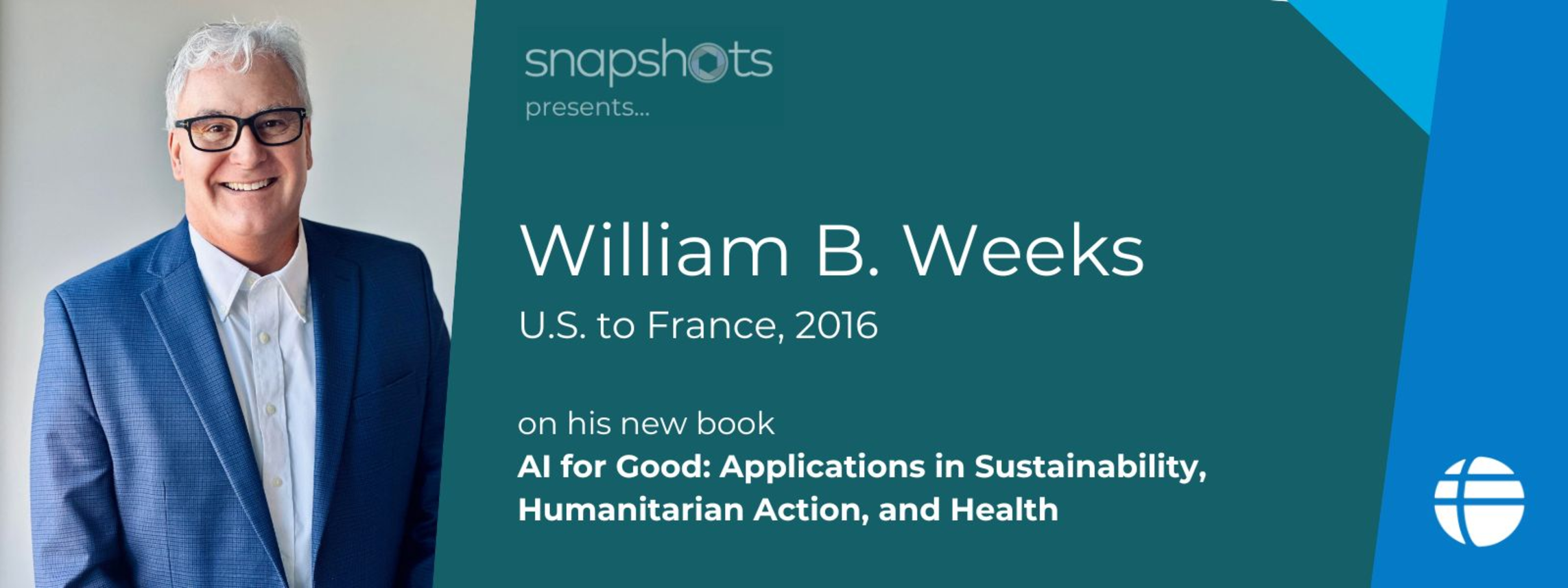
Snapshots presents William B. Weeks on 'AI for Good: Applications in Sustainability, Humanitarian Action, and Health'
"...a key learning that each project revealed is that one company – even one as large as Microsoft – cannot solve these world challenges alone. Collaboration, particularly public-private efforts that incorporate subject matter expertise and technical expertise, is key to resolving complex problems."
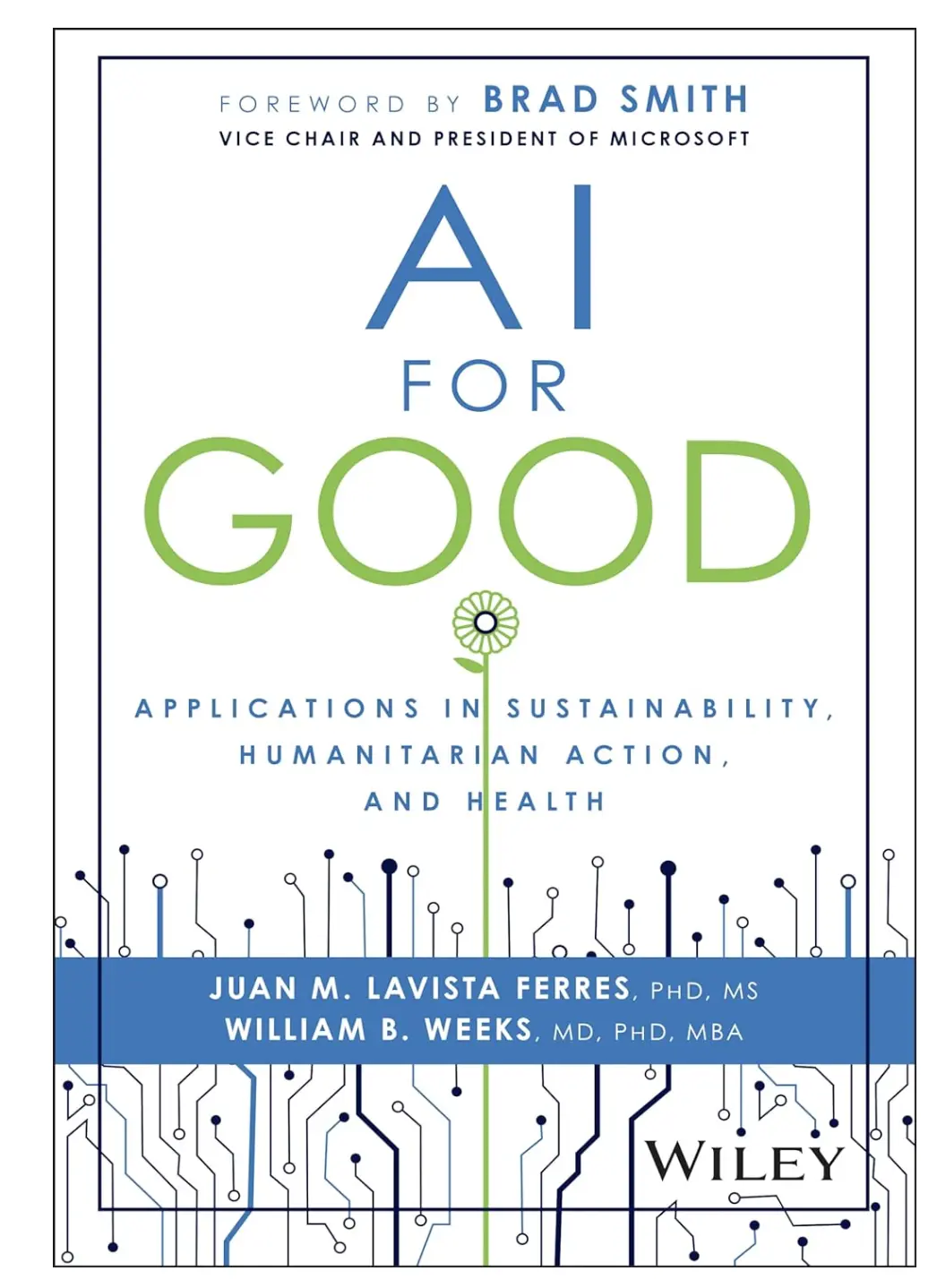
Could you tell us more about your new book AI for Good: Applications in Sustainability, Humanitarian Action, and Health?
I work in Microsoft’s philanthropic AI for Good Research Lab, which is directed by my co-author, Juan Lavista Ferres, PhD. Since its inception, the AI for Good Research Lab has partnered with numerous organizations to collaborate on research projects that use artificial intelligence (AI) to grapple with problems in sustainability, humanitarian action, and health.
After a brief introduction to AI – including what it is and how it can be used to address the world’s most challenging problems – the book provides numerous examples of how the lab has collaborated and used AI to do so. Written for the lay person, the book uses a common format for each chapter that includes a summary of the project, a background describing why we chose to work on that particular problem, a non-technological overview of the methods used, the findings, and what we learned as a lab from the project.
With the book, we hope to articulate successful approaches to these complex problems and the value of collaboration across private and public sectors and across countries. In the spirit of doing good in the world, 100% of author royalties from the book’s sales go to support humanitarian relief efforts.
In your role as the director of Microsoft’s AI for Health program, can you share more about what inspired you to write AI for Good?
The world faces increasingly complex problems. Fortunately, with a plethora of new data sources – including satellite data, remote sensors, camera traps, and genomics data – and new data analytic approaches, solving some of those complex problems is within our grasp. Unfortunately, perhaps, most data scientists focus on how to generate more clicks on websites. However, supported by Satya Nadella and Brad Smith, Microsoft’s philanthropic AI for Good Research Lab employs a cadre of data scientists, engineers, and computer scientists who can dedicate themselves to using AI to help solve these problems and promote equity, across the world. Part of the inspiration for writing the book was because I am proud of being part of the Lab and of the work that the Lab does.
In addition, a key learning that each project revealed is that one company – even one as large as Microsoft – cannot solve these world challenges alone. Collaboration, particularly public-private efforts that incorporate subject matter expertise and technical expertise, is key to resolving complex problems. So, I wanted to articulate the importance of such collaboration and provide examples of how that collaboration can be successful.
Finally, I wanted to inspire hope in readers. The world’s complexity can feel overwhelming and some of its problems unsolvable, particularly in low- and middle-income countries. In the book, we provide examples of how a measured, thoughtful, collaborative approach can actually work to improve within- and cross-country equity. If we can succeed, so can others!
How have your experiences as a Fulbrighter influenced this book?
I spent 2016 as the Fulbright-Tocqueville Distinguished Chair at Aix-Marseille University in Marseille, France, where I worked with health economists – particularly Bruno Ventelou, PhD, and Alain Paraponaris, PhD – to study the French healthcare system and variation in care across French départements. That experience very much expanded my world view. At Aix-Marseille University, I taught an introduction to health services research; many of the students were from sub-Saharan Africa, so I gained some insight into the challenges that they and their countries faced, particularly with regard to health and healthcare.
That experience made me wonder whether newer analytic approaches might be used to address those challenges. This combination of exposure to very bright health economists, a different healthcare system, and the articulated healthcare needs of those who had lived in low- and middle-income countries all converged to make me seek to learn more, join Microsoft Research a couple of years after the Fulbright, take the job leading the AI for Good Research Lab’s AI for Health effort, and write the book.
A second Fulbrighter influence is more personal. My youngest kid – then sixteen – was able to join me in Marseille and attend the local lycée. Through him, I learned about the French educational system’s approach to learning, and he learned about the Fulbright program. In 2021, he obtained a Fulbright to obtain a master’s degree in cognitive neuroscience in Paris, and, by good fortune, I was on a Microsoft assignment there that year. So, the Fulbright experience directly broadened my world view and, both indirectly and directly, broadened my son’s. To see the next generation both facing major world challenges and learning about how to address them inspires me. So, part of the reason I wrote the book was to provide some inspiration, hope, and exemplars for future generations.
More about William
William B. Weeks, MD, PhD, MBA, is a Physician-Economist leading Microsoft’s Philanthropic AI for Health effort. There, he conducts research in concert with not-for-profit organizations and academic centers designed to improve health and health outcomes by applying AI in imaging, public health, and large language modeling.
Dr. Weeks has published two books and over 250 peer-reviewed manuscripts examining economic and business aspects of health care services utilization and delivery, physicians’ return on educational investment, health care delivery science, and healthcare value. Dr. Weeks has been honored with the 2009 National Rural Health Association Outstanding Researcher Award, the 2016 Jerome F McAndrews award for excellence in research from the National Chiropractic Medical Insurance Corporation Group, the 2016 Fulbright-Tocqueville Distinguished Chair at Aix-Marseille University, and a 2020-23 Fulbright Specialist Award.