
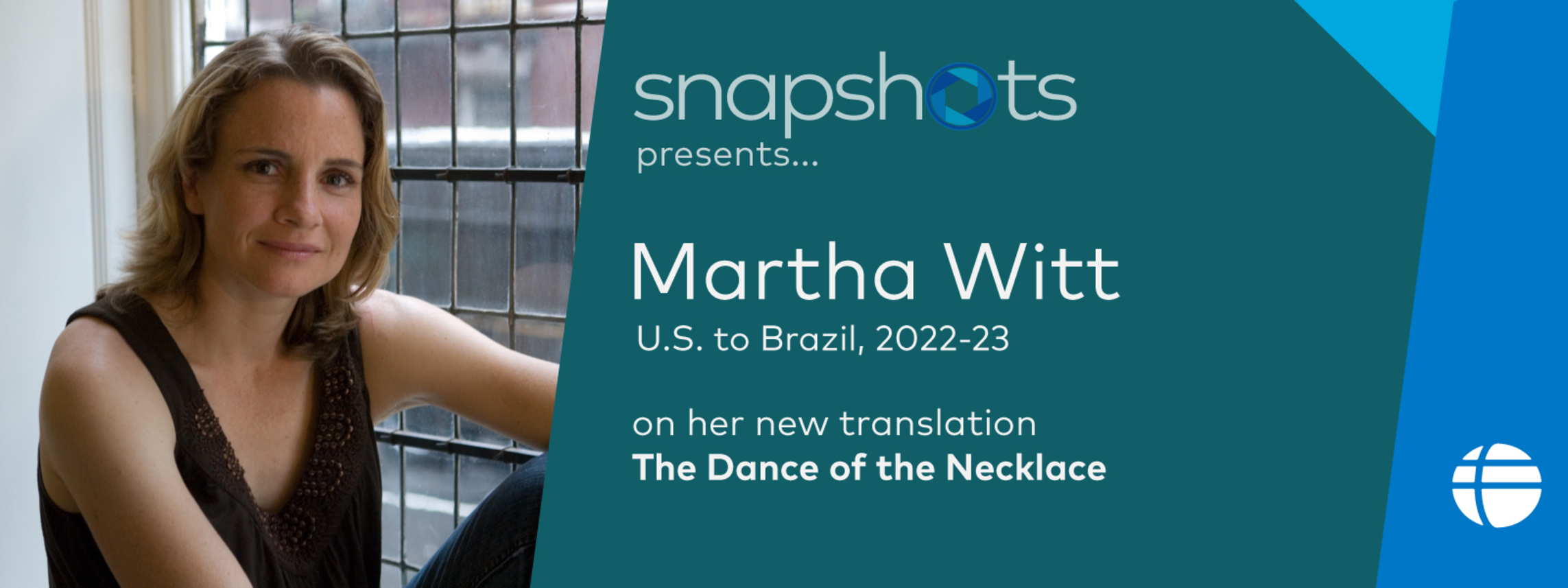
Snapshots presents Martha Witt on 'The Dance of the Necklace'
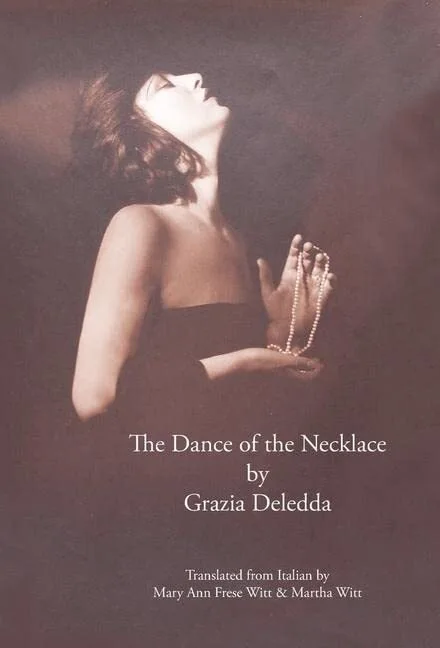
This modernist novel is a book about what it means to be a woman, aging and alone, in a world where she is increasingly invisible despite her lingering desires.
Could you tell us a little about The Dance of the Necklace and some of the challenges of translating Deledda’s prose?
The Dance of the Necklace, written by Grazia Deledda, the first Italian woman writer to win the Nobel Prize for Literature, is one of her few novels that does not take place in the countryside of her native Sardinia. The pearl necklace at the heart of this novel symbolizes the "dance" of jealousy, greed, and love, both erotic and familial, which unites and divides the three main characters: an aunt and her niece, and a young count seeking to regain his family's bartered string of pearls. In a spare, experimental style, this modernist novel is, in the end, a book about what it means to be a woman, aging and alone, in a world where she is increasingly invisible despite her lingering desires.
According to the critic Margherita Heyer-Caput, the novel is one of Deledda's "most conscious and disquieting expressions of modernity." It challenges the labels often applied to this writer and overturns established critical categories. The Dance of the Necklace is the first translation into English of Deledda’s La Danza della Collana, published in 1924.
When translating Grazia Deledda’s work, I remind myself that Deledda, who published over thirty novels in addition to plays, poetry, hundreds of short stories, and even a screenplay, was herself a translator. Not only had she translated Balzac's Eugénie Grandet into Italian (1930), but her own works are, in a sense, translations from her mother tongue, Sardo. The literal meaning of translation, from Latin, is to “carry over,” and one of the joys in translating Deledda is the sense of navigating the two languages of the original text while trying to “carry over” the foreign culture to the familiar one. Translating Deledda involves a particular attention to word choice, nuances, musicality, and allusions, considerations that inevitably lead to a deeper appreciation of her work.
Dr. Mary Ann Frese Witt, my co-translator, and I are currently translating The Mother, another Deledda novel scheduled for publication in fall of 2024.
How is your Fulbright award in Brazil enriching your upcoming novel, The Truth Lies Between, and your wider creative practice?
The Truth Lies Between, a novel based on my mother-in-law’s real life story and set in post-World War II, opens with an introduction to Celia, a teenaged girl from Montemurro, a small town in southern Italy. Barely eighteen years old, Celia, in effect, is “sold” by her mother and grandfather to Signor Tiziano Lombardi, a middle-aged man, now a widower, who emigrated to Ilhéus, Brazil from Montemurro years before Celia was even born.
Celia’s family, now starving and penniless, receives a request from Signor Lombardi asking that they sign marriage papers and send their daughter to Ilhéus to be his wife. In exchange for his new bride, the Signore promises a good monthly stipend. After all, he has become one of Ilhéus’s “cacao barons” and can afford to offer a generous stipend. Celia’s grandfather and mother, in what they see as the only way to save the family from starvation, sign the requisite papers. So, Celia, who has never met this husband of hers, or traveled beyond Montemurro’s walls, who has never seen the ocean or a ship or a person of color, is forced onto a steam liner headed for Rio de Janeiro, where her husband will meet her before boarding a boat to Ilhéus.
I chose to set this novel in Ilhéus rather than in Rio, where my mother-in-law’s actual story unfolded, for a couple of reasons. When I first visited this city years ago, I was struck by all the natural beauty as well as by the colonial architecture in various stages of decline. The story of cacao, which produced both sudden riches and terrible poverty, the decimation of crops by Witches Broom up and down the “cacao coast,” and the cultural and religious synchretism of Candomblé and Catholicism, metaphorically coincide with many themes within my novel. In addition, the legend of St. George, who happens to be the patron saint of both Ilhéus and Montemurro, reverberates in interesting ways with Celia’s own story.
Living in Ilhéus, meeting the city’s inhabitants, spending time in the natural surroundings, and learning Portuguese, have had, and will continue to have, a deep influence on how I render the characters as well as the setting of this novel. I am, of course, inspired to work in the city that Jorge Amado, Adonias Filho, and other Bahian writers have made so prominent in Brazilian literature.
Who are the writers that have had the greatest impact on your life so far?
Rachel Cusk is a writer whose work I cannot stop going back to again and again. I find her able to craft a sentence in a way that slips the reader into the text as though no language is mediating, and yet language is doing all the work. I am astounded by Damien Galgut’s use of point of view to achieve multiple complex feats. Sigrid Nunez writes with such deceptive subtlety that, by the end of one of her novels, readers cannot pinpoint why they feel so moved. I love Fitzgerald. I just always have. I am currently reading Bernadine Evaristo and am quite taken by fusion fiction.
About
Martha Witt is the author of the novel Broken as Things Are (Henry Holt, 2004; Picador, 2005). Her short fiction, some of which has been translated into Italian, has appeared in One Story, AGNI, Boulevard Magazine, The Literary Review, Smokelong Quarterly, Narrative Magazine, and many other national literary journals and anthologies. The recipient of a Watson Grant, a New York Times Fellowship, a MacCracken Fellowship, a Cepell Scholarship for Translation, and a Fulbright Fellowship, she has also held several residencies at the Yaddo, VCCA, and Ragdale artist colonies. In collaboration with Mary Ann Frese Witt, she translated Luigi Pirandello’s Six Characters in Search of an Author (Italica Press, 2013) and Henry IV (Italica, 2016), as well as Grazia Deledda’s Ivy (Italica, 2019) and The Dance of the Necklace (Italica, 2023). Her translation of Grazia Deledda’s The Mother is scheduled for publication by Italica Press in 2024. Martha is a professor of English and creative writing at William Paterson University.